Good bathroom lighting ideas do two jobs at once: they make the room pleasant to be in, and they let you see your face clearly at the mirror. Many bathrooms get only one of the two, usually a single ceiling fixture that lights the floor well and leaves shadows under the eyes and chin.
This guide walks through the three layers of light, the best options at the vanity, what to choose for a small or windowless room, how bulb color changes the look of tile and makeup, and the safety rules that apply near water.
Start With Three Layers of Light
Lighting designers plan a bathroom in layers, and the idea works just as well for a powder room as for a large primary suite:
- Ambient light: the general light that fills the room, from a ceiling fixture, recessed downlights or a flush mount.
- Task light: bright, even light at the mirror for shaving, skincare and makeup.
- Accent light: soft light that adds mood and helps at night, such as an LED strip under a vanity or inside a shower niche.
Each layer should have its own switch, or at least its own dimmer. That way you can have full brightness on a busy morning and a gentle glow for a bath in the evening.
Vanity Lighting Ideas: Light the Face, Not the Top of the Head
The mirror is where lighting matters most. A fixture directly overhead casts light down onto the brow and nose, which creates shadows under the eyes. Light that comes from the sides, at roughly face height, reaches the face evenly.
Sconces on each side of the mirror
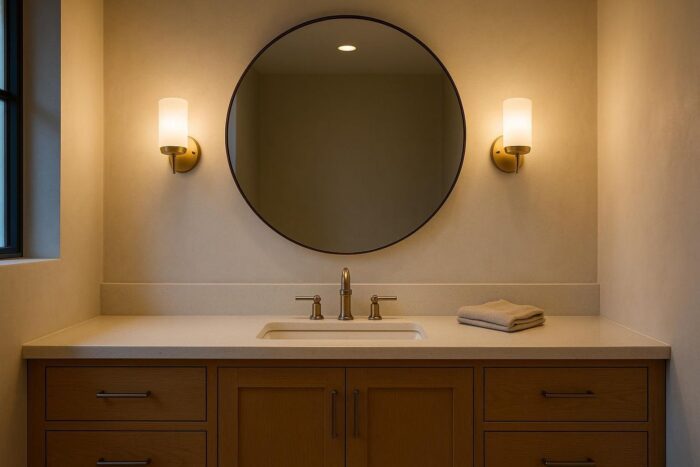
A pair of wall sconces flanking the mirror is the most flattering setup. It works especially well above a double vanity, where each sink can have its own mirror with a sconce on either side. Choose shades in frosted glass or fabric-look diffusers rather than bare bulbs, which can glare.
A bar light above the mirror
When the mirror runs wall to wall, or when there is no room beside it, a horizontal fixture mounted above the mirror is the practical choice. A longer fixture spreads light more evenly. Bar lights that point slightly forward and down light the face better than ones that wash only the wall.
A lighted mirror
Backlit or front-lit mirrors put the light source right where you need it and take no extra wall space. Check whether the model plugs in or must be hardwired, and whether it is rated for bathroom use. Some include an anti-fog pad that clears the glass after a shower.
Ceiling and Ambient Lighting Ideas
The ambient layer sets the overall brightness of the room.
- Recessed downlights: clean and discreet, good in modern and small bathrooms. Place them so they do not sit directly above your head at the mirror.
- Flush or semi-flush fixture: a decorative option for a standard ceiling height, available in styles from vintage glass to minimal discs.
- Pendant or small chandelier: a striking focal point in a larger bathroom, as long as it hangs outside the zone around the tub and shower described below.
- Combination fan and light: useful in a small room where the ceiling has space for only one unit.
Accent and Night Lighting
Accent light is the layer that makes a bathroom feel finished.
- Under-vanity LED strip: a floating vanity with a strip of light underneath creates a soft glow on the floor and works as a night light.
- Lit shower niche: a waterproof LED strip in a niche highlights the tile and makes bottles easy to find.
- Toe-kick lighting: low lights along the base of cabinets guide you at night without waking you up fully.
- Motion sensor night light: a simple plug-in option for renters and children’s bathrooms.
Bulb Color and Quality: Why It Changes Everything
A few details on the bulb box make a big difference in a bathroom.
| Spec | What it means | Common choice for bathrooms |
|---|---|---|
| Color temperature (kelvin) | Lower numbers look warm and yellow, higher numbers look cool and blue | Warm white, around 2700K to 3000K, for a relaxed feel; some prefer slightly cooler light at the mirror |
| CRI (color rendering index) | How accurately the light shows colors, on a scale up to 100 | A high CRI, often 90 or above, so skin tones and makeup look natural |
| Dimmable | Whether the bulb works with a dimmer switch | Check that bulb and dimmer are compatible to avoid flicker |
Keep the same color temperature throughout the room. Mixing warm and cool bulbs makes white tile look patchy and can shift paint colors, which matters if you chose your palette carefully. Our guide to bathroom color ideas explains how bulbs can push a gray toward beige or blue.
Lighting Ideas for a Small or Windowless Bathroom
In a small room, light does more than help you see. Bright, even light makes walls recede, while a single dim fixture makes the space feel tighter.
- Light the mirror first. If you can only add one fixture, put it at the vanity.
- Bounce light off light surfaces. Pale walls, glossy tile and a large mirror spread light further.
- Use slim fixtures. Flush mounts and low-profile sconces keep walls and ceilings clear.
- Add a lighted mirror or medicine cabinet when there is no wall space beside the mirror for sconces.
- Do not forget the shower. A dark shower corner makes the whole room feel smaller; a recessed fixture rated for wet locations fixes it.
For more ways to make a tight room work, from layout to storage, see our full guide to small bathroom ideas.
Safety Rules Around Water
Bathrooms come with specific electrical rules, and they are worth knowing before you fall for a fixture.
- Damp and wet ratings: fixtures in a bathroom should be suitable for damp locations, and fixtures inside a shower or where they can be hit by shower spray need a wet location rating. The rating is printed on the box or the label.
- The zone around the tub and shower: the National Electrical Code does not allow pendants, chain-hung fixtures, track lighting, cord-connected fixtures or ceiling fans within 3 feet horizontally and 8 feet vertically from the top of the bathtub rim or shower threshold.
- Ground-fault protection: bathroom receptacles must be GFCI protected, which matters for plug-in lighted mirrors and accent lights.
Local codes can add their own requirements, so have a licensed electrician handle new wiring, especially for recessed lights in a shower ceiling or a fixture above a tub.
Planning Lighting During a Remodel
If you are remodeling, decide on lighting before the walls are closed. Sconce boxes need to be placed according to the mirror width and height, a heavy fixture may need blocking in the wall, and under-vanity strips need a power source hidden behind the cabinet. Our bathroom remodel ideas cover how lighting fits into the order of work alongside tile, plumbing and storage.
Bathroom Lighting FAQ
What is the best lighting for a bathroom vanity?
Sconces on both sides of the mirror at roughly face height give the most even light. A bar light above the mirror or a lighted mirror are good alternatives when side space is limited.
Can I hang a chandelier over a bathtub?
Not within the zone the electrical code protects: 3 feet horizontally and 8 feet vertically from the tub rim. In a room with a high ceiling, an electrician can tell you whether a fixture above that zone is allowed where you live.
What color light is best for a bathroom?
Warm white, around 2700K to 3000K, suits most bathrooms. A high CRI matters more than many people think, because it shows skin and makeup colors accurately.