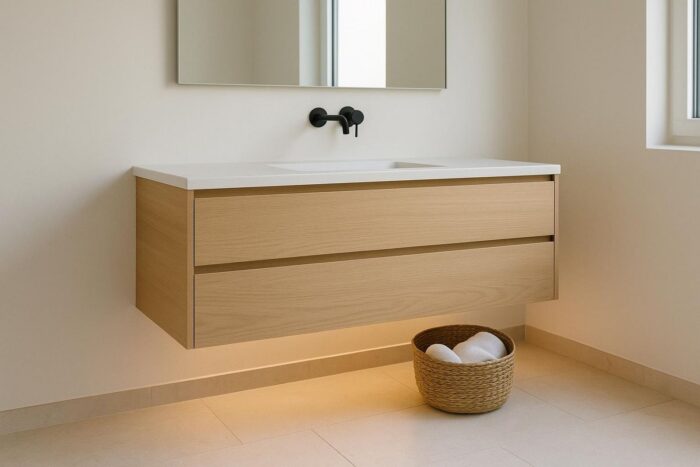
A floating vanity is mounted to the wall with nothing touching the floor beneath it. That gap of visible floor makes a bathroom look larger, makes cleaning easier and gives the room a lighter, more modern feel. It also asks more of the wall and the plumbing than a vanity that stands on the floor.
Here are floating vanity ideas by style and size, how they compare with freestanding vanities, what to check before installation and how to get the most storage out of a cabinet with no base.
Floating vs. Freestanding: Pros and Cons
| Floating vanity | Freestanding vanity | |
|---|---|---|
| Look | Light and open, shows the floor | Solid and furniture-like |
| Cleaning | Easy to mop or vacuum underneath | Dust collects around the base or legs |
| Height | Set at the height you choose when mounting | Fixed by the cabinet |
| Storage | Usually less for the same width | Usually more, down to the floor |
| Installation | Needs solid wall support and wall-exit plumbing | Simpler, works with floor drains |
For a small bathroom, the visible floor is often worth the lost storage. In a bathroom with little other storage, a freestanding cabinet or a floating vanity with deep drawers may be the better balance.
Floating Vanity Ideas by Style
Warm wood
A wood floating vanity in oak, walnut or a wood-look finish is one of the most popular combinations, because it adds warmth to white or stone tile. Paired with a white quartz top and brushed brass faucets, it reads as modern but soft.
Matte color
Painted fronts in navy, sage, black or warm white turn the vanity into the room’s color accent. Our bathroom vanity ideas go further into colors, backsplashes and hardware.
Slab and integrated sink
A thin slab top with a molded basin and handleless drawers is the most minimal option. It suits modern bathrooms with large-format tile and frameless mirrors.
Open shelf below
A floating vanity with one drawer above an open shelf feels even lighter. Rolled towels or baskets on the shelf keep it practical, though open storage needs to stay tidy.
Floating double vanity
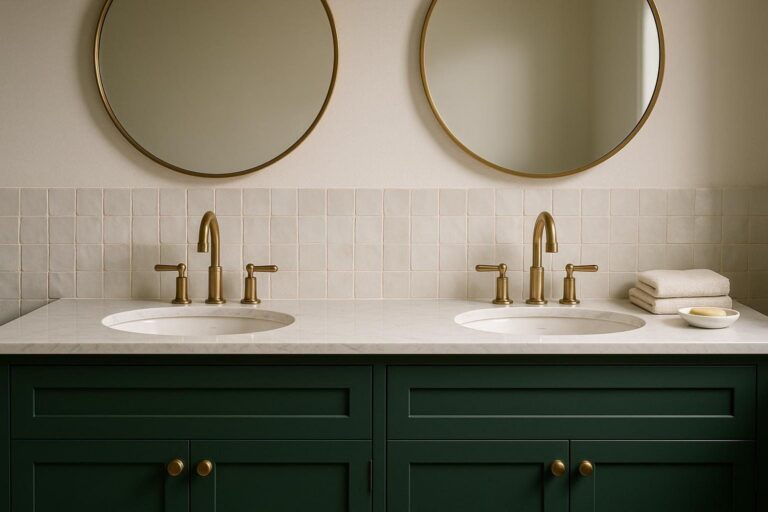
A long floating vanity with two sinks gives a primary bathroom a calm, continuous line. Wide units are heavy, so they need especially secure mounting along their full length.
Floating Vanity Ideas for Small Bathrooms
A floating vanity is often recommended for small bathrooms, for good reasons:
- More visible floor makes the room read as larger.
- Shallow depths are widely available, which keeps the walkway clear.
- Room for a basket or scale underneath, without adding furniture.
- Height flexibility: mount it at comfort height for adults or lower for a children’s bathroom.
Our guide to choosing a small bathroom vanity covers widths and depths for tight rooms in more detail.
How High to Mount a Floating Vanity
Vanities are generally sold in two height ranges: about 30 to 32 inches for traditional height and about 34 to 36 inches for comfort height, measured to the top of the counter. A floating vanity lets you pick any height within reason. When you choose, consider:
- The sink type: a vessel sink adds height above the counter, so the cabinet usually goes lower.
- Who uses the room: tall adults often prefer comfort height; children and seated users need a lower counter.
- The space below: leaving enough room underneath to clean easily is part of the appeal.
- The mirror and lights: the vanity height sets the position of everything above it.
What to Check Before Installing
A floating vanity is only as good as its installation. Before you buy:
- Wall support: the vanity must be fixed into studs or into solid blocking added between the studs. A loaded vanity with a stone top is heavy, and someone may lean on it.
- Plumbing position: the drain and supply lines need to come out of the wall at a height that fits inside the cabinet. If they come up through the floor, they will be visible below the vanity and usually need to be moved.
- Wall type: masonry, tile over backer board and older plaster each need appropriate fixings. Follow the manufacturer’s instructions.
- Electrical: under-vanity lighting or an outlet inside a drawer needs wiring planned before the vanity goes on the wall.
- Flooring: the floor under the vanity will be visible, so finish it fully instead of stopping the tile at the cabinet line.
Moving a drain or adding blocking means opening the wall, which is easiest during a remodel. Ask a plumber when in doubt.
Storage Ideas for a Floating Vanity
With no space down to the floor, every inch inside the cabinet counts.
- Drawers instead of doors: drawers bring everything into view and make better use of depth.
- U-shaped drawers: they wrap around the drain so the upper drawer stays usable.
- Drawer dividers: keep small items like razors and hair ties in order.
- A basket underneath: a low woven basket holds towels while keeping the floating look.
- Wall storage above: a recessed medicine cabinet or a shelf adds what the vanity cannot hold.
For more storage beyond the vanity, see our small bathroom storage ideas.
Lighting Under a Floating Vanity
An LED strip under the cabinet is a classic floating vanity detail. It washes the floor with soft light, makes the vanity look as if it hovers, and doubles as a night light. Use a strip suited to damp locations, keep the driver accessible, and choose a warm color temperature so it feels calm rather than clinical.
Floating Vanity FAQ
Are floating vanities strong enough?
Yes, when they are fixed into studs or solid blocking following the manufacturer’s instructions. The wall structure matters as much as the cabinet.
Do floating vanities have less storage?
Usually, for the same width, because there is no cabinet down to the floor. Drawers and wall storage make up the difference.
Can I install a floating vanity if my drain comes from the floor?
The pipes would be visible below, so the drain is usually moved into the wall. That is a plumbing job best done during a remodel.
Is a floating vanity good for a small bathroom?
It is one of the most effective choices, because the visible floor makes the room feel larger and easier to clean.