Good kitchen lighting ideas all rest on one principle: no single fixture can do every job. A ceiling light fills the room, but it casts your shadow onto the counter the moment you start chopping. The fix is to layer several kinds of light, each with a clear purpose.
Designers usually talk about three layers: ambient light for the whole room, task light for the work surfaces, and accent light for mood and display. Here is how to plan each one, which bulbs to choose, and how to adapt it all to a small kitchen.
The three layers of kitchen lighting
| Layer | What it does | Typical fixtures |
|---|---|---|
| Ambient | Lights the whole room evenly so you can move around safely | Flush mounts, recessed lights, track lights |
| Task | Puts bright, shadow-free light where you cook, prep and wash | Under-cabinet lights, pendants over an island or sink, range hood lights |
| Accent | Adds depth, highlights shelves or glass cabinets, sets an evening mood | In-cabinet lights, toe-kick strips, wall sconces, small lamps |
Put each layer on its own switch, ideally with a dimmer. That way you can work under full brightness at dinner time and keep only the accent lights on later in the evening.
Ambient light: the ceiling layer
The ceiling layer is the base. In most kitchens it comes from one of these options:
- Recessed lights. They spread light without taking visual space, which suits low ceilings. Place them over the front edge of the counters rather than in the center of the floor, so the light lands in front of you instead of behind you.
- Flush or semi-flush fixtures. A simple, practical choice in rentals and small rooms, and easy to swap.
- Track or rail systems. Useful when you cannot add new ceiling boxes: one electrical point can feed several adjustable heads aimed at different areas.
Avoid relying on one bright fixture in the center of the room. It flattens the space and creates shadows at every counter.
Task lighting where you actually work
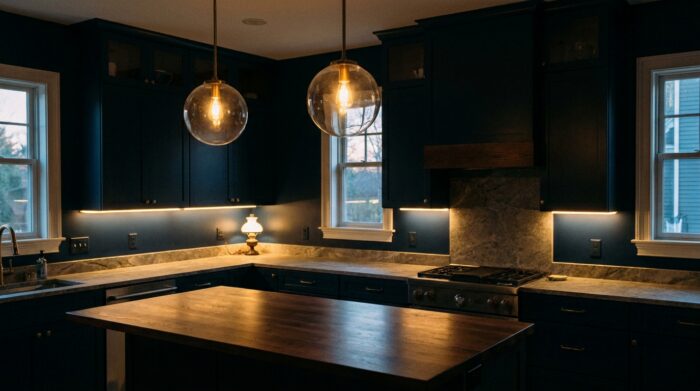
Task lighting is the layer that changes how a kitchen feels to cook in. The most useful upgrade in most homes is under-cabinet lighting. LED strips or slim bars mounted toward the front of the upper cabinets light the counter directly, with no head in the way. A diffuser or a channel hides the individual LED dots and gives a smooth line of light on glossy counters.
Other task lights to consider:
- Pendants over an island or peninsula. A common rule of thumb is to hang them roughly 30 to 36 inches above the counter, high enough to see across but low enough to light the surface. Space them evenly and leave some distance from the ends of the counter.
- A light over the sink. A single pendant, a sconce or a recessed light makes washing up easier, especially at a window where there is no upper cabinet.
- The range hood light. Many hoods include one. Check that it works and that the bulb is bright enough.
Accent lighting for depth and mood
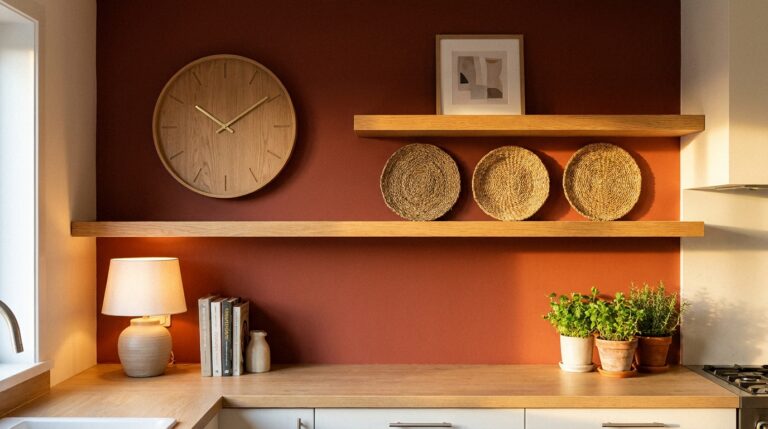
Accent light is the layer people skip, yet it is what makes a kitchen pleasant after dark. Small LED pucks inside glass-front cabinets show off dishes. A strip in the toe kick under the base cabinets makes the cabinets look like they float, and doubles as a night light. Lighting above the upper cabinets washes the ceiling and makes it feel higher. A plug-in sconce or a small lamp on the counter brings a warm, living-room feel to a kitchen that opens onto a dining or living area.
Choosing bulbs: brightness and color
Two numbers on the box tell you most of what you need. Brightness is measured in lumens, not watts. According to ENERGY STAR, a bulb that replaces a 60-watt incandescent should give at least 800 lumens. Kitchens generally need more light than living spaces, so plan generously and use dimmers to turn it down.
Color temperature is measured in kelvins (K). Lower numbers give warmer, yellower light, and higher numbers give cooler, bluer light. Warm white around 3000K is a popular choice in kitchens: warm enough to feel welcoming, clear enough to see what you are cooking. Whatever you pick, keep the same color temperature across all fixtures in the room, or the mix will look patchy.
Also look at the color rendering index (CRI), a measure of how faithfully light shows colors. A higher CRI makes food, wood and paint look true, which matters when you are checking whether chicken is cooked or matching paint samples.
Lighting ideas for a small kitchen
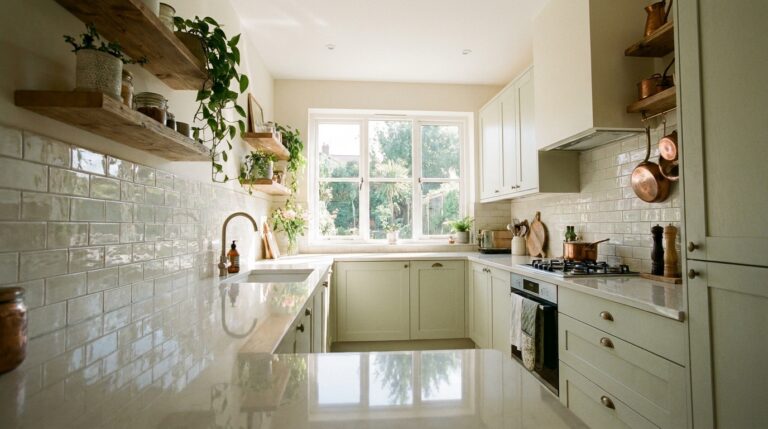
A small kitchen benefits even more from layered light, because shadows and dark corners make it feel tighter. A few ideas suit compact rooms especially well:
- Prioritize under-cabinet lighting. In a galley or a one-wall kitchen, it often does more for usability than any ceiling fixture.
- Choose low-profile ceiling fixtures. Flush mounts and recessed lights keep sight lines open under a low ceiling.
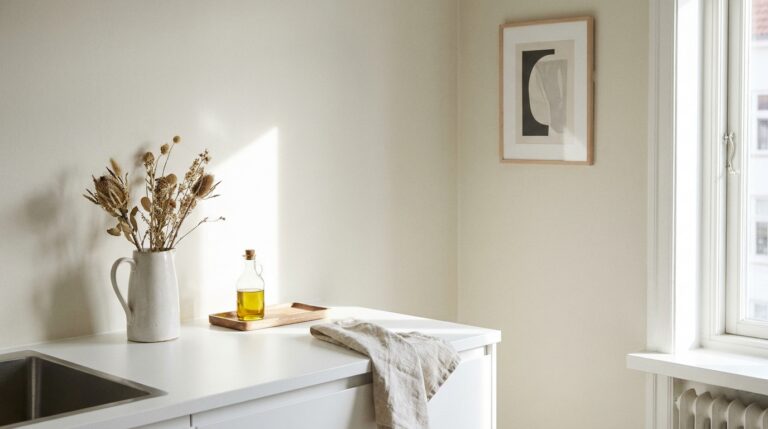
- Light the walls and ceiling. Bright vertical surfaces make a room read larger. Uplighting above the cabinets or a sconce aimed at a wall helps.
- Pick one statement piece, not three. A single pendant over a small table or peninsula adds character without crowding the space.
- Go plug-in when you rent. Rechargeable or plug-in under-cabinet bars, plug-in sconces and countertop lamps add light without an electrician.
Light works hand in hand with color and layout in a compact room. For the rest of the picture, from storage to layouts, see our roundup of ways to make a compact kitchen feel bigger and work better.
Mistakes to avoid
- Mixing color temperatures. Cool white strips under a warm white ceiling light look disjointed.
- Placing recessed lights behind you. Lights in the middle of the floor throw your shadow onto the counter.
- Glare on shiny surfaces. Exposed LEDs reflect as dots on polished stone. Use diffusers and mount strips toward the front of the cabinet.
- Everything on one switch. Separate controls and dimmers are what make layered light useful.
- Skipping permits and electricians for hardwired work. New circuits and fixtures should follow local electrical code.
Controls and smart options
Layered lighting only pays off if it is easy to control. Dimmers are the most useful upgrade: they let the same fixtures go from bright prep light to a soft glow at dinner. Make sure LED bulbs and fixtures are labeled dimmable and compatible with the dimmer you choose, or they may flicker or hum.
Smart bulbs and switches add scenes, such as a cooking scene with everything at full brightness and an evening scene with only the under-cabinet and accent lights. Motion sensors work well for toe-kick lights and inside a pantry. Whatever system you use, keep a simple wall switch that anyone in the house can operate without a phone.
Lighting by kitchen layout
- One-wall kitchen. Under-cabinet strips along the full run, plus a ceiling fixture or two placed over the front edge of the counter.
- Galley kitchen. A row of recessed lights or a slim track down the center, and under-cabinet lighting on both sides.
- L-shaped and U-shaped kitchens. Pay attention to the corners, which are often the darkest spots; extend under-cabinet lights all the way into them.
- Kitchen with an island. Pendants over the island, recessed lights around the perimeter, and under-cabinet light on the wall runs.
Frequently asked questions
What is the best lighting for a kitchen?
A combination: ambient light from the ceiling, task light under the cabinets and over work areas, and a little accent light. Each layer on its own switch gives the most flexibility.
What color temperature is best for a kitchen?
Many people choose warm white around 3000K for a balance of warmth and clarity. Use the same temperature for every fixture in the room.
How high should pendants hang over an island?
A common guideline is about 30 to 36 inches above the counter. Adjust for your height and ceiling so the fixtures do not block the view across the room.
Is under-cabinet lighting worth it?
Yes. It lights the counter directly with no shadow from your body, and it is one of the most effective upgrades for a small kitchen.