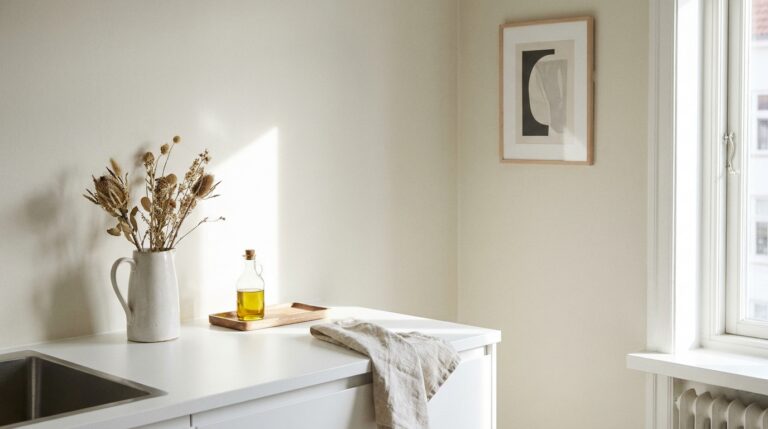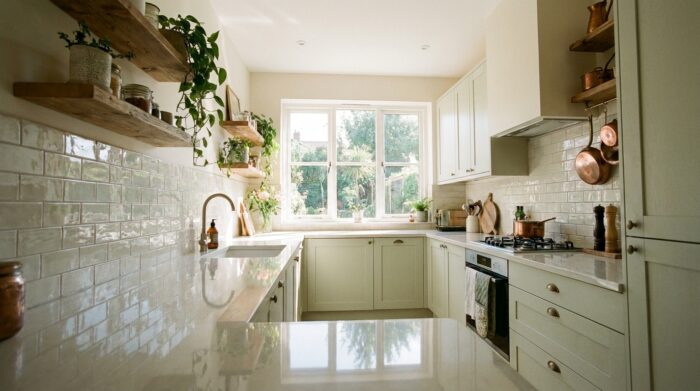
The right small kitchen paint colors can make a cramped room feel open, bright and calm. Light shades bounce more light around, and fewer contrasts let the eye move freely, which makes walls seem farther away. That does not mean every small kitchen has to be white, but it helps to know which colors stretch a space and which ones close it in.
Here is how to choose, from the lightest whites to tone-on-tone schemes and the occasional dark color that works against the odds.
Why light colors make a kitchen look bigger
Pale colors reflect more of the light that reaches them, so the room looks brighter and the corners less heavy. Many paint chips list a light reflectance value (LRV), a scale from 0 for black to 100 for a perfect white. The higher the number, the more light the color sends back into the room. In a small kitchen with one window, or none, a high-LRV wall color makes a visible difference.
Undertone matters too. Cool colors such as pale blues and grays tend to recede, while warm colors feel closer and cozier. In a small kitchen, a light color with a slightly cool or neutral undertone often gives the most open feel, but warm whites suit rooms with little natural light.
Best light colors for a small kitchen
| Color family | Effect | Works best with |
|---|---|---|
| Warm white | Bright but soft, never stark | Wood cabinets, north-facing rooms |
| Clean white | Crisp and airy | Modern flat-panel cabinets, stainless steel |
| Pale gray | Calm, slightly receding | White or gray counters, cool light |
| Soft greige | Neutral bridge between warm and cool | Mixed materials, beige floors |
| Pale sage | Fresh, natural, still light | White cabinets, brass hardware |
| Light blue | Airy, recedes visually | White tile, light wood |
Warm whites: the safest bet
A white with a hint of yellow, red or beige avoids the cold, clinical look a bright white can take on in a kitchen, especially under artificial light. Warm whites flatter wood and stone, and they look good at night when the room is lit by bulbs rather than daylight. If your kitchen faces north or sits deep inside an apartment, start here.
Test any white against your cabinets and counters. Next to a creamy countertop, a cool white can make the counter look dingy. Next to a gray floor, a very yellow white can look dated.
Tone on tone for a seamless look
One of the most effective tricks in a small kitchen is to paint walls, trim and even cabinets in the same color, or in two or three close shades of it. When there are no sharp lines where the wall meets the trim or the cabinet, the eye stops measuring the room. The kitchen reads as one continuous volume, which makes it feel larger.
Use the same color in different finishes to keep it interesting: satin on the walls, semi-gloss on the trim and cabinets. Painting the ceiling in a lighter version of the wall color, or the same color, also blurs the top edge and makes the room feel taller.
Colors and tricks that make a kitchen feel bigger
- Match the backsplash to the walls. A light backsplash in the same tone as the walls removes another visual break.
- Paint upper cabinets the wall color. They fade into the wall, and only the lower cabinets read as furniture.
- Go lighter at the top. Darker lower cabinets with light uppers and walls ground the room without closing it in.
- Keep accent colors small. Bring in stronger color through a runner, a stool or a bowl, not across a whole wall.
- Light the walls. Even the best paint color looks dull in shadow. Good under-cabinet and ceiling lighting does as much as the paint.
Can you use a dark color in a small kitchen?
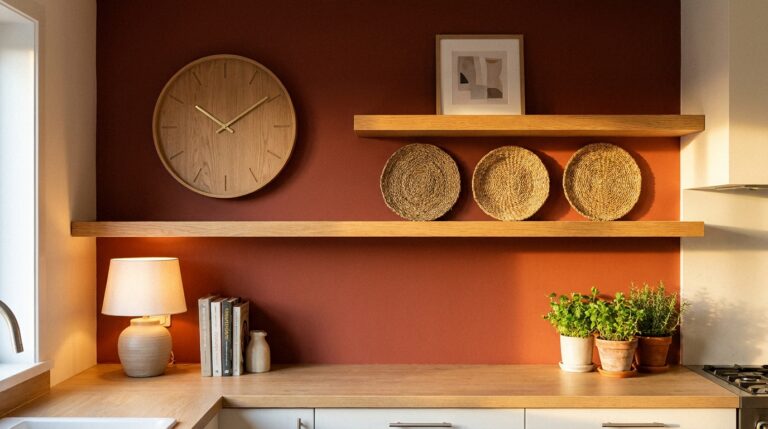
Yes, with care. A deep green, navy or charcoal applied to every surface can make a small kitchen feel cozy and intentional rather than cramped, because the edges of the room disappear in the same way they do with tone-on-tone white. It works best when the room has strong lighting, light counters for contrast, and no competing colors. What rarely works is one dark wall in a small room, which pulls that wall forward and makes the space feel narrower.
Paint is only one of the levers. For broader palettes, wall, cabinet and backsplash pairings and the right paint finishes, read our kitchen color ideas. And if you are planning the whole room, our guide to making the most of a compact kitchen covers layout, storage and lighting.
How to test paint colors in a small kitchen
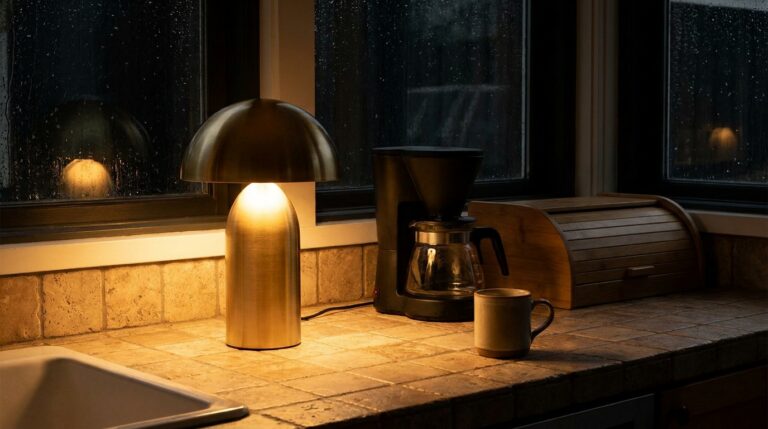
Small rooms magnify color, so a shade often looks darker and more saturated on four walls than on a chip. Paint large sample boards, or patches of at least a couple of feet square, and place them on different walls: next to the window, in the darkest corner, beside the cabinets. Look at them in the morning, in the afternoon and at night under your own bulbs. A white that looks perfect at noon can turn yellow or gray after dark. Live with the samples for two or three days before you decide.
Frequently asked questions
What color makes a small kitchen look bigger?
Light colors with a high light reflectance value, such as warm or clean whites, pale grays and soft blues, make a small kitchen look larger, especially when walls and cabinets share one tone.
Should a small kitchen be all white?
It does not have to be. Pale greens, blues and greiges also open up a room. What matters is keeping the palette light and limited.
What paint finish suits a small kitchen?
Satin on walls is easy to clean and gives a soft glow that reflects light. Use semi-gloss on trim and cabinets.