Small kitchen appliances can make cooking faster and easier, but in a compact kitchen each one competes for the same few feet of counter. The goal is not to own fewer appliances for the sake of it. It is to keep the ones you use often, choose machines that do several jobs, and store the rest so the counters stay free for chopping and cooking.
This guide helps you sort which small appliances for the kitchen are worth their space, which multifunction models replace several gadgets, and how to store everything in a small kitchen without clutter.
The once-a-week rule
A simple test decides where each appliance belongs:
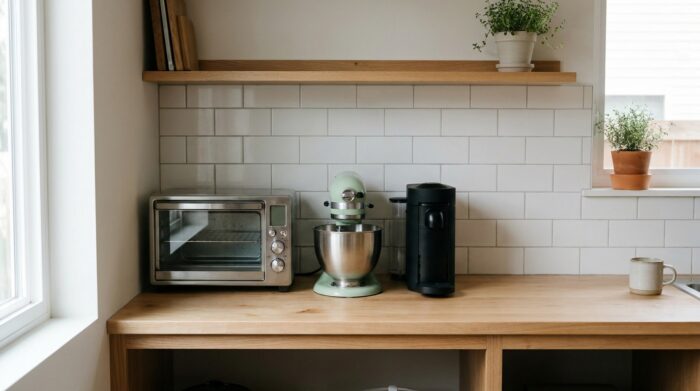
- Used daily: it can stay on the counter, ideally plugged in and close to where you use it. Think coffee maker, kettle or toaster.
- Used weekly: it goes in a cabinet that is easy to reach, at counter height or just below.
- Used a few times a year: high shelf, pantry, closet or under the bed. A waffle maker or ice cream machine does not need prime real estate.
- Not used in a year: consider donating or selling it.
Writing down for a week or two which appliances you actually use often gives surprising answers.
Multifunction small kitchen appliances that replace several gadgets
Combining functions is the best way to save space. Look at the categories below before buying single-use devices.
| Appliance | What it can replace | Good for |
|---|---|---|
| Multicooker (electric pressure cooker) | Slow cooker, rice cooker, steamer, sometimes yogurt maker | Batch cooking, beans, soups, grains |
| Countertop convection oven with air fry | Toaster, air fryer, sometimes a small second oven | Small households, reheating, roasting small portions |
| Microwave with convection or grill mode | Microwave plus small oven | Studios and kitchens without a full oven |
| Immersion blender with attachments | Countertop blender, hand mixer, mini chopper | Soups, sauces, smoothies, small chopping jobs |
| Food processor with dough and slicing discs | Mandoline, grater, sometimes stand mixer for small batches | People who cook from scratch often |
| Electric kettle with temperature control | Stovetop kettle, coffee water heater | Tea and pour-over coffee |
The catch with multifunction devices is size: an all-in-one machine is usually bigger than any single gadget it replaces. It saves space only if it truly replaces two or more appliances you would otherwise keep.
Compact versions of everyday appliances
Many small kitchen appliances come in compact sizes designed for apartments and small households:
- Compact coffee makers or single-serve machines take a fraction of the counter of a full 12-cup brewer. A manual pour-over or French press can live in a cabinet.
- Two-slice toasters instead of four-slice models, or a toaster oven that also replaces the toaster.
- Mini food choppers for small daily jobs like garlic, herbs and onions.
- Personal blenders with a single cup, for smoothies and dressings.
- Portable induction burners, a single cooking zone that can be stored away and brought out as an extra burner. Induction only works with magnetic cookware, such as cast iron and many stainless steel pans.
- Compact stand mixers exist for occasional bakers who want the stand mixer experience on a smaller footprint.
Major appliances in compact sizes
Small kitchens can also gain space with compact versions of the larger appliances:
- 24-inch ranges instead of the standard 30-inch width.
- 18-inch dishwashers instead of 24 inches, or countertop dishwashers in rentals where no cabinet space is available.
- Counter-depth or 24-inch-wide refrigerators, which stay flush with the cabinets.
- Over-the-range microwaves that combine microwave and range hood, freeing the counter.
- Combination washer-dryers where laundry has to fit in the kitchen.
Before buying, check the exact cutout dimensions, door swings and electrical requirements. Compact appliances often have specific outlet or circuit needs.
How to store small appliances in a small kitchen
Appliance garage
An appliance garage is a cabinet at counter level with a door that lifts, slides or rolls up. The coffee maker, toaster and blender stay plugged in and ready to use, but disappear behind a door when you are done. It can be built into a corner where the counter is hard to use anyway.
Pull-out shelves and lift-up mechanisms
Heavy machines such as a stand mixer are easier to use when stored on a pull-out shelf or a lift-up mixer shelf in a base cabinet, instead of being lifted from a low shelf every time.
Rolling carts
A narrow kitchen cart on casters can hold the appliances you use several times a week and roll next to an outlet when needed. The top doubles as extra prep space.
Wall and under-cabinet options
Some appliances can be mounted to free counter space: a microwave on a shelf or in a cabinet, a paper towel holder or a knife strip under the cabinets. Always follow the manufacturer’s guidance on ventilation and heat clearance; appliances such as toaster ovens and air fryers need space around them while running.
Group by task
Store appliances near where you use them: the kettle and coffee maker with mugs and coffee, the food processor near the prep area, the multicooker near the stove. A coffee station on one stretch of counter keeps everything in one place.
Before you buy: a quick checklist
- Measure the real footprint, including the space needed to open a lid or a door, and the height under your upper cabinets.
- Check the capacity against the size of your household. A 3-quart multicooker suits one or two people; a family usually needs more.
- Look at the cleaning: removable, dishwasher-safe parts make it much more likely that you will use the appliance often.
- Count the attachments. Every disc, blade and lid needs a place to live; a storage case or a box in the same cabinet keeps them together.
- Choose a consistent finish. Appliances that stay on the counter look calmer in matching colors or materials, which helps a small kitchen feel less busy.
Waiting a few weeks before buying a new gadget is also a good filter: if you still miss it after a month of cooking without it, it has probably earned its place.
Which small appliances can you skip?
Some single-use appliances are worth reconsidering when space is tight:
- Egg cookers, hot dog toasters and popcorn machines: a pot, a pan or the microwave do the job.
- A separate rice cooker if you already own a multicooker.
- A bread machine if you bake bread only occasionally; a stand mixer or your hands can knead.
- A separate air fryer if you already have a convection toaster oven with an air fry setting.
Choosing well is just one part of making a compact kitchen work. For storage, layout, lighting and color, our guide to small-space kitchen ideas goes through every room decision step by step.
Safety and energy tips
- Do not overload a single outlet with several heating appliances running at once; kitchen circuits can trip.
- Look for a safety certification mark from a nationally recognized testing laboratory on electrical appliances.
- Unplug appliances that heat when not in use, and keep cords away from the sink and stove.
- Leave the space around heating appliances recommended in the manual, especially under upper cabinets.
Small kitchen appliances: FAQ
What are the most useful small kitchen appliances for a small kitchen?
For most households, an electric kettle or coffee maker, a toaster oven with air fry mode, an immersion blender and a multicooker cover a wide range of tasks while taking little space.
How do I hide small appliances in a small kitchen?
Use an appliance garage, a tall cabinet with pull-out shelves, a rolling cart or a pantry shelf. Keep only daily-use appliances on the counter.
Is a toaster oven better than a toaster in a small kitchen?
Often yes. A toaster oven toasts, bakes, roasts and reheats, and many models include an air fry function, so it can replace two or three appliances.
Are compact major appliances worth it?
In a small kitchen, compact options such as a 24-inch range or an 18-inch dishwasher free counter and cabinet space. They suit smaller households best, since capacity is reduced.