The best kitchen curtain ideas solve two problems at once: they soften a room full of hard surfaces and they keep enough light and air coming in to cook comfortably. In a kitchen, a window treatment also has to survive steam, grease and the occasional splash, so practicality matters as much as style.
Below are the main options, from café curtains to shades, with advice on fabrics, sizes and the details that keep them safe and clean.
Café Curtains
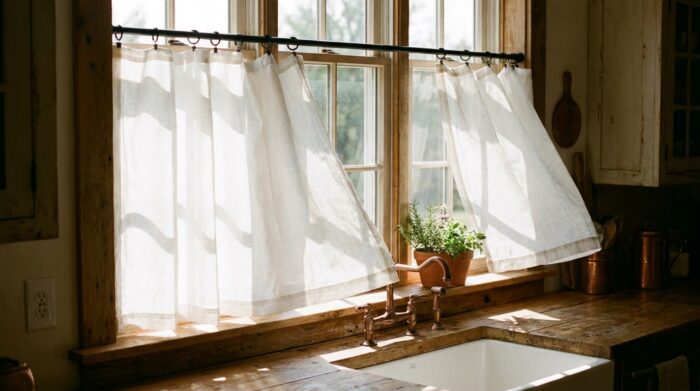
Café curtains cover only the lower half of the window, hung on a rod set at mid-height. They give privacy at counter level while the top half lets daylight in, which makes them a classic choice for a window over the sink or one facing the street.
- Use a slim tension rod inside the frame for a no-drill installation.
- Choose a light cotton or linen that you can wash often.
- Gingham, ticking stripes or plain white suit farmhouse and vintage kitchens; a solid linen in a muted color looks more modern.
Roman Shades
A Roman shade folds up into neat pleats and lies flat when lowered. It looks tailored, takes no space on either side of the window and works well when the window sits close to a cabinet or a wall. A flat Roman shade in a patterned fabric can become the main color note of the kitchen.
For a window above the sink, mount it inside the frame and choose a fabric that dries quickly. A lined shade blocks more light; an unlined one filters it softly.
Valances
A valance is a short fabric panel across the top of the window. It frames the view without covering any of the glass, so it is a good option when you want a decorative touch but no loss of light. Straight, box-pleated or gently gathered valances all work; scalloped or balloon styles can feel dated unless they fit a clear vintage look.
Pair a valance with café curtains below for a traditional look, or use it alone above a window that does not need privacy.
Blinds and Roller Shades
When easy cleaning comes first, blinds and roller shades are hard to beat.
- Roller shades: a plain or printed vinyl or treated fabric shade wipes clean and disappears into a slim roll at the top.
- Faux wood blinds: they resist humidity better than real wood and let you tilt the slats to control light.
- Bamboo or woven shades: they add texture and warmth, but keep them away from the sink and stove since they are harder to clean.
- Cellular shades: they insulate well, useful for a large or drafty window.
Comparing Window Treatment Ideas for the Kitchen
| Option | Privacy | Light | Cleaning | Best spot |
|---|---|---|---|---|
| Café curtains | Lower half | Top half open | Machine washable | Over the sink, street-facing windows |
| Roman shade | Adjustable | Filtered or blocked | Spot clean or dry clean, depending on fabric | Tight spots beside cabinets |
| Valance | None | Full | Machine washable | Windows with a view or no privacy need |
| Roller shade | Full when lowered | Adjustable | Wipe clean | Busy kitchens, near the sink |
| Faux wood blinds | Adjustable | Tilt to control | Wipe slat by slat | Humid kitchens, sunny windows |
| Floor-length panels | Full when closed | Adjustable | Machine washable | Patio doors and dining areas |
Choosing Fabrics That Handle Kitchen Life
Steam and cooking fumes settle on everything, so kitchen curtains need regular washing. Cotton, linen and polyester blends are the usual choices: they go in the machine and dry quickly. Check the care label before buying, and prewash cotton or linen if the label warns about shrinking, so the curtains keep their length.
Light colors and small patterns hide water marks and fading better than dark solids. If the window gets strong afternoon sun, a lining protects the fabric and the colors last longer.
Whatever you choose, keep curtains and shades well away from the cooktop. A window directly beside or behind the stove is better served by a wipeable roller shade or blinds than by loose fabric.
Safety: Go Cordless if Children Live Here
The U.S. Consumer Product Safety Commission recommends cordless window coverings wherever young children are present, because looped and dangling cords are a strangulation hazard. If you keep corded blinds, the CPSC advises making pull cords as short as possible and keeping them out of children’s reach, while noting that these steps reduce the risk without removing it. Many shades and blinds are now sold in cordless or motorized versions.
Curtain Ideas for Small Kitchens
In a compact kitchen, the window is often the only source of daylight, so the treatment should block as little as possible. Mount shades inside the frame, or raise the rod above the window and extend it a little past the sides so the glass stays fully uncovered when the curtains are open. A sheer café curtain or a simple valance is often enough.
Light, airy fabric also helps the room feel larger, one of many tricks for making a tight kitchen feel bigger and work better alongside smart storage and a clear layout.
Curtains also pair well with the rest of the room’s decor. Picking up the color of your towels, chair cushions or a runner ties everything together; our kitchen decorating ideas show how to build that palette around accessories, textiles and plants.
Kitchen Curtain FAQ
What kind of curtains are best for a kitchen?
Short, washable treatments: café curtains, valances or Roman shades in cotton, linen or a polyester blend. They let in light and are easy to clean.
Should kitchen curtains be long or short?
Short in most cases, ending at the sill or the counter, so they stay clear of water and food. Floor-length panels fit patio doors or a dining nook.
What can I use instead of curtains over a kitchen sink?
A roller shade, faux wood blinds or frosted window film give privacy and wipe clean, which suits the wettest spot in the kitchen.
Can you put curtains near a stove?
It is better not to. Choose a wipeable shade or blinds for any window close to the cooktop and keep fabric well away from the burners.