The right small bathroom tile ideas can make a cramped room feel noticeably more open, without moving a single wall. The main levers are simple: bigger tiles, fewer grout lines, a light and limited palette, and continuity from floor to wall to shower.
This guide covers each of those levers, then goes surface by surface (floor, walls, shower) so you can plan a tiny bathroom that looks calm rather than crowded.
The four rules of tile in a small bathroom
- Fewer lines, more calm. Every grout joint is a line the eye has to cross. Larger tiles and grout that matches the tile both reduce visual noise.
- Light colors reflect light. Whites, warm off-whites, pale stone and soft pastels push the walls back.
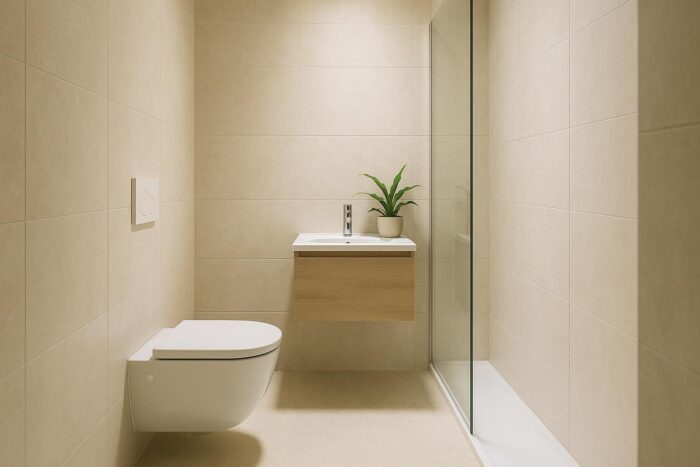
- Continuity erases edges. The same tile on the floor and in the shower, or the same color on floor and walls, makes the room read as one volume.
- One focal point only. A patterned floor or a feature wall, not both.
Large tile in a small bathroom: does it really work?
Yes, and it is one of the most effective tile ideas for small bathrooms. A floor laid in 12 x 24 inch tiles shows far fewer joints than the same floor in 4 inch squares, so it looks more spacious. On walls, large rectangular tiles give a sleek, modern finish.
A few caveats. Tile is considered large format when a side reaches 15 inches, and those sizes need a flat subfloor and wall. Industry guidance calls for grout joints of at least 1/8 inch for rectified large tile and 3/16 inch for calibrated tile, and an offset of no more than about one third when laying them in a brick pattern. In a very tiny bathroom, oversized tiles can also mean lots of cuts around the toilet and vanity, so lay the pattern out on paper before buying.
Small bathroom floor tile ideas
The floor is often the smallest surface in the room, so it is a good place for either quiet continuity or a controlled dose of pattern.
- Large, light porcelain with matching grout for the most open look.
- Wood-look planks laid along the longest wall to stretch the room.
- A diagonal layout, which makes the longest sightline run corner to corner.
- Patterned or checkerboard tile as the single focal point, with plain walls.
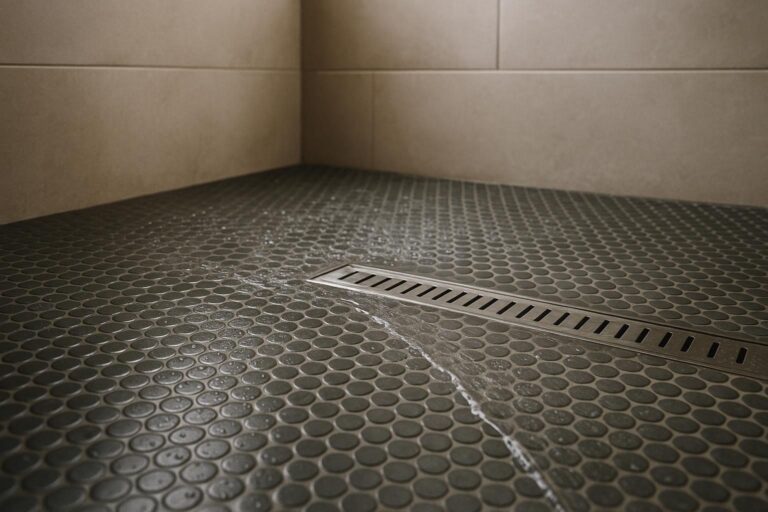
- Hexagon or penny mosaics for grip and character, best in a single color so the pattern stays subtle.
Whatever the look, check slip resistance. Under ANSI A326.3, tile for level interior floors that get wet should have a wet DCOF of 0.42 or higher.
Small bathroom wall tile ideas
Fully tiled small bathrooms
Fully tiled small bathroom ideas carry the tile from floor to ceiling on every wall. This removes the horizontal break where tile meets paint, making the ceiling feel higher. Using the same tile, or the same color, on floor and walls creates a seamless box that feels larger than its dimensions.
Subway tile, updated
Small bathroom subway tile ideas remain popular because subway tile is affordable and easy to live with. To make it work harder in a small room, lay it vertically to add height, stack it straight for a cleaner modern look, or choose a longer, slimmer format. White grout keeps it airy; a darker grout adds graphic lines, which can make a tiny room feel busier.
Half height with paint above
Tiling the lower wall and painting the upper part is budget friendly and lets you add color. Keep the tile line level with a natural reference point such as the top of the vanity or a window sill so the wall does not look chopped at random.
Tile shower ideas for small bathrooms
In a small bathroom, the shower is often the largest tiled area, so it sets the tone.
- Run the floor tile into the shower if the tile is rated for wet floors and works with the drain slope. Code requires a slope of 1/4 to 1/2 inch per foot toward the drain; a linear drain makes large tiles easier to use.
- Tile to the ceiling. The International Residential Code only requires a nonabsorbent finish up to 6 feet above the floor in the shower, but full height makes the room feel taller.
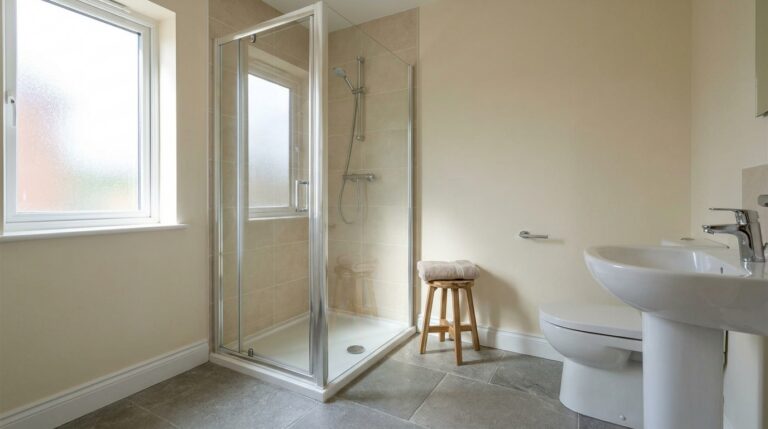
- Swap a curtain for clear glass so the tile continues visually past the shower line.
- Add a recessed niche instead of a hanging caddy, and tile its back in an accent color for a small, contained pop.
- Keep the back wall as the focal point if you want pattern, and leave the side walls plain.
Colors and grout for a tiny bathroom
Light neutrals are the safe choice, but they are not the only one. A soft green, pale blue or blush tile across a whole small room can feel enveloping in a good way, as long as the palette stays limited to two or three tones. Dark tile works best on a single surface, such as the floor or the shower back wall, with light walls elsewhere.
Grout is the detail that most often makes or breaks a small room. Matching grout blends tiles into one surface. A slightly darker mid-tone on floors hides dirt without drawing lines across the room.
Where to go next
If you are still weighing materials, patterns and color pairings for a bathroom of any size, our full article on choosing bathroom tile goes deeper into porcelain, marble looks, accent walls and painted tile. Tile is only one piece of a compact room, though: layout, storage and lighting matter too, and our complete collection of space-saving bathroom tips covers them all.
Small bathroom tile FAQ
Should I use big or small tiles in a small bathroom?
Big tiles usually make a small bathroom look larger because they have fewer grout lines. Small mosaics still make sense on the shower floor, where they add grip and follow the slope.
What color tile is best for a small bathroom?
Light, warm neutrals and soft pastels reflect the most light. Keep the palette to two or three tones and use matching grout.
Should the floor and wall tile be the same in a small bathroom?
Using the same tile or the same color on both is one of the easiest ways to make the room feel bigger. If you want contrast, change only the size or only the color.
Is a fully tiled small bathroom a good idea?
It looks seamless and is easy to wipe down, and it can make the ceiling feel higher. It uses more material than half height tile, so weigh that against your budget.