A small kitchen lamp does something ceiling lights cannot: it adds a pool of warm, low light that makes the kitchen feel lived in. Countertop lamps used to be a decorator’s trick, but they have become a practical choice in small kitchens, rentals and open-plan spaces where hardwiring a new fixture is not an option.
This guide covers the two main types, cordless and plug-in, how big a lamp should be, which bulb to choose, and where a lamp works best in a compact kitchen.
Why put a lamp in a kitchen?
Overhead light handles the basics, and under-cabinet strips light the work surface. A small lamp adds the third layer, accent light. It softens the room in the evening, lights a dark corner, and makes a kitchen that opens onto a living area feel like part of the home rather than a workspace. Turned on alone after dinner, it also works as a gentle night light.
A lamp is not a replacement for task lighting, though. It is too low and too warm to light chopping and cooking properly.
Cordless or plug-in?
| Cordless (rechargeable) | Plug-in | |
|---|---|---|
| Placement | Anywhere, including shelves and islands with no outlet | Near an outlet |
| Look | No visible cable | Cord to hide or route along the backsplash |
| Brightness | Usually modest, often dimmable | Can take a stronger bulb |
| Maintenance | Needs regular recharging | None beyond changing the bulb |
| Best for | Ambiance, moving around, outdoor dinners | A fixed spot used every evening |
Cordless lamps run on a built-in rechargeable battery and usually charge by USB. They are ideal for an island, an open shelf or a table where no outlet is nearby. Battery life varies widely between models and with the brightness setting, so check the manufacturer’s figures before buying. Plug-in lamps are the simpler choice for a fixed spot next to an outlet, such as the corner of the counter near the backsplash.
What size works on a counter?
Kitchen counters sit under upper cabinets, which limits height. In most kitchens there is a gap of roughly a foot and a half between the counter and the bottom of the upper cabinets, so measure yours before you shop and leave a few inches of clearance above the shade for heat and for a tidy look. Mini lamps or compact table lamps fit this space best.
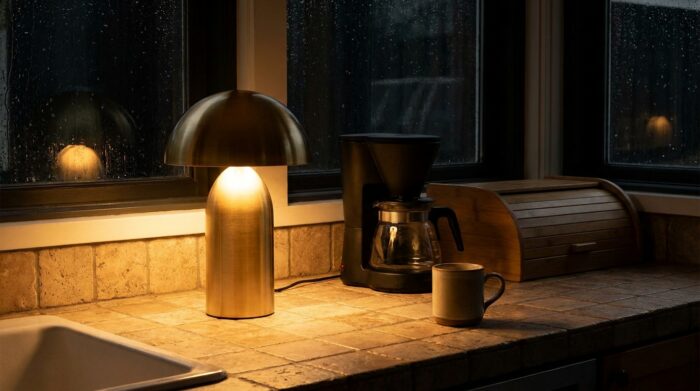
Keep the footprint small too. A narrow base and a shade no wider than the lamp is tall usually works on a counter, where every inch counts. Mushroom-shaped lamps, small cylinders and glass globes are popular because they take little room and have no protruding parts.
Choosing the bulb and light
- Color: warm white light is the point of a kitchen lamp. Many cordless lamps use built-in LEDs with a fixed warm tone or adjustable settings.
- Brightness: modest output is fine for accent light. A dimmer or several settings let you switch from evening glow to a little extra light.
- Shade: an opaque shade directs light down onto the counter, while a glass or fabric shade glows softly in all directions.
- Heat: LEDs stay much cooler than old bulbs, which matters on a counter near food and cabinets.
Where to place a lamp in a small kitchen
- In a corner of the counter. The classic spot, where it lights a dark angle and does not get in the way of prep.
- Next to the coffee station. A small lamp turns a coffee corner into a cozy nook for early mornings.
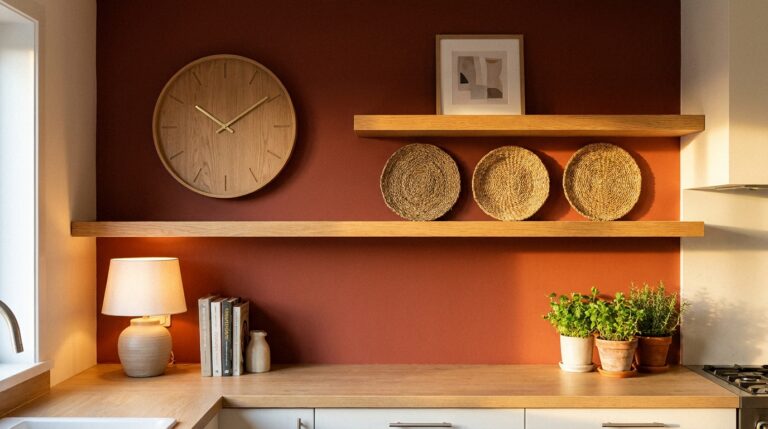
- On an open shelf. A cordless lamp among plates and jars adds depth to the wall.
- On a small island or peninsula. Good for evenings when the kitchen doubles as the dining room.
- In a window sill. If the sill is deep enough, a lamp adds a welcoming glow seen from outside.
Keep lamps away from the sink, the cooktop and the oven. Water and heat are the two things a lamp, and especially a battery, should not be near. Follow the manufacturer’s instructions for charging, and do not leave a lamp charging next to a hot appliance.
A lamp is the finishing touch of a layered plan. To build the full scheme, from ceiling lights to under-cabinet strips, see our kitchen lighting ideas. For layout, storage and color tips that make the most of every inch, browse our practical guide to compact kitchen design.
Styles that suit a small kitchen
Pick a lamp that echoes something already in the room, so it looks planned rather than borrowed from another space. A ceramic base in the same tone as the backsplash, a brass lamp that matches the cabinet hardware, or a simple glass globe in a white kitchen all blend in. In a farmhouse kitchen, a small lamp with a pleated fabric shade feels at home; in a modern one, a matte metal mushroom shape or a clear cylinder works better.
One lamp is usually enough in a small kitchen. Two can work at both ends of a long counter or on either side of a window, but more than that starts to clutter the surface you need for cooking.
Frequently asked questions
Are cordless lamps good for a kitchen?
Yes, for accent light where there is no outlet, such as an island or open shelf. They need regular recharging and are not bright enough for task lighting.
How tall should a countertop lamp be?
Measure the gap between your counter and the upper cabinets, then choose a lamp a few inches shorter so it sits comfortably under them.
Can I leave a kitchen lamp on all night?
Check the manufacturer’s guidance. An LED plug-in lamp on a dim setting is generally fine, but keep any lamp away from water and heat.